



Start here
What’s This About
For half a century the polo shirt has been read as the uniform of golf clubs, campus quads and dress-down Fridays. That reading is recent, and it was never the whole story.
This feature follows the shirt from a French tennis court in 1926 to Brooklyn, London and today’s menswear runways, and shows why the same collared knit now looks as natural under a soft suit as it does over wide-leg denim.
Key Points
01René Lacoste first wore his short-sleeved piqué tennis shirt in 1926, as a practical revolt against starched long sleeves.
02The preppy reputation came later, through American campus dress and Ralph Lauren’s Polo shirt of 1972.
03British Mods and Brooklyn’s Lo Lifes took the same shirt and made it say something else entirely.
04Fabric and proportion now decide what a polo communicates, far more than the emblem on the chest.
05The collar is what lets one garment move between sportswear and tailoring.
A revolt in white piqué
The polo shirt was born as a complaint about comfort. In the 1920s a tennis player dressed for the court much as he dressed for the office, in a long-sleeved woven shirt, flannel trousers and often a tie.
René Lacoste, the French champion ranked world number one in 1926, found that uniform stiff and hot. His answer was a white short-sleeved shirt in loosely knitted cotton petit piqué, with a soft unstarched collar, a short buttoned placket and a back hem cut longer than the front so it stayed tucked in mid-rally.
According to Smithsonian Magazine, he first wore it at the 1926 US Championships in New York.
In 1933 he went into business with André Gillier, who ran France’s largest knitwear firm, and the shirt went into production as the L.12.12. The code is wonderfully literal. L for Lacoste, 1 for petit piqué, 2 for short sleeves, and 12 because it was the twelfth prototype.
Even the name is borrowed. In 1896 John E. Brooks of Brooks Brothers watched a polo match in England, noticed the players had buttoned their collar points down to stop them flapping, and took the idea home.
The firm still calls its oxford button-down the Original Polo shirt. The knitted tennis shirt only inherited the word later.
In 1952 Fred Perry, three times a Wimbledon champion, launched his own white piqué version at Wimbledon with a laurel wreath on the chest. None of these men was thinking about class. They were thinking about sweat.
How a sports shirt became a uniform
The conservative reading arrived through America. On Ivy League campuses in the late 1950s and early 1960s, sportswear crept into daily dress, and the Japanese photo book Take Ivy (1965) captured those students so precisely that it became a style bible in Tokyo.
The Museum at FIT’s Ivy Style exhibition later traced how that campus look hardened into an international one, a story our history of preppy fashion from Ivy campuses to neo-prep follows in detail.
Then, in 1972, Ralph Lauren put a small polo player on a cotton mesh shirt and sold it in a spectrum of colours. It became shorthand for American leisure, the shirt you wore to the club, the boat and the family photograph.
By the 1990s the same silhouette had a second, duller life as the default of the corporate dress-down day, often with a company logo stitched where the crocodile or pony used to sit.
Success is what boxed the polo in. A garment designed for freedom of movement ended up signalling that you knew the rules. If you want the campus version at its source, our guide to Ivy League fashion covers it.
The subcultures got there first
Long before designers deconstructed the polo, young men in two cities had already hijacked it. In early-1960s Britain, Mods wore their polos buttoned right to the throat under sharp three-button suits, with Clarks desert boots below.
The twin-tipped Fred Perry shirt became part of the kit, and the laurel wreath went on to serve ska fans, skinheads and Northern Soul dancers as a badge of belonging. A tennis shirt had become a tribal flag.
In Brooklyn in 1988, two shoplifting crews from Brownsville and Crown Heights merged into the Lo Lifes, led by Thirstin Howl the 3rd and Rack-Lo.
Their obsession was Polo Ralph Lauren, worn head to toe in matching seasons, with the big logos and loud colour blocking the brand never meant for their streets.
Howl later put it plainly, saying they “took it, remixed it, and we made it our own”. When MoMA’s Items: Is Fashion Modern? chose the polo shirt as one of the 111 garments that shaped the past century, the museum’s audio guide told the polo’s story through the Lo Lifes.
Same shirt, opposite meanings. The polo never had fixed politics. The man wearing it supplied them.
Designers now treat the polo as raw material
Today’s designers have picked up where those subcultures left off. Wales Bonner, whose collections draw on vintage sport and an Afro-Atlantic view of classic dress, has made merino polos with John Smedley and a striped wool polo shot through with crochet panels.
Martine Rose, steeped in London’s music subcultures, cuts hers either shrunken like an old football shirt or oversized and panelled. Prada sells a garment-dyed piqué polo in an oversized cut with side slits, the classic shape blown out of proportion on purpose.
The heritage labels have moved too. Lacoste, the house that started it all, now offers its men’s polo shirts in classic, slim and loose fits, from the original L.12.12 petit piqué to stretch piqué, which tells you how far proportion now matters even at the source.
Classic sportswear can change its cut without losing its structure. The collar, the placket and the short sleeve stay. Everything around them is open to argument.
Fabric and proportion do the talking
For decades the default polo was a single formula, mid-weight cotton piqué cut either boxy or tight, built to show the emblem first and the man second.
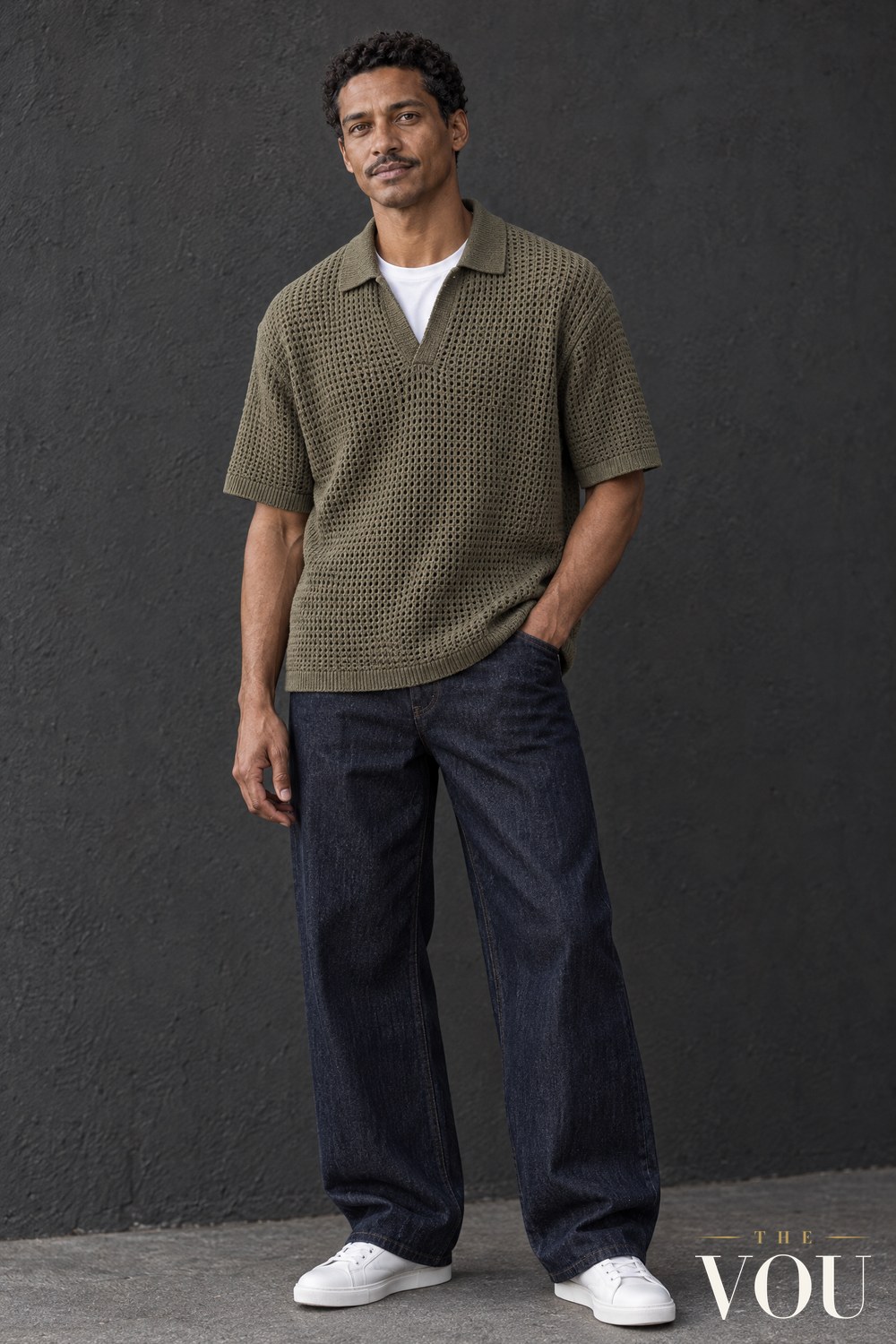
The more interesting versions now speak the language of knitwear. Fine-gauge merino drapes like a good jumper. Open-weave and crochet knits let light through. Waffle, terry and heavy brushed jersey add surface that flat piqué rarely had.
The Johnny collar, a knitted collar with no buttons that meets in a short open V, softens the neckline further. Worn loose over a plain white T-shirt, with dropped shoulders and sleeves that reach the elbow, an open-knit polo stops reading as sportswear at all.
It reads as a choice. Our guide to knitted polo shirts for an old money look covers the classic end of this territory.
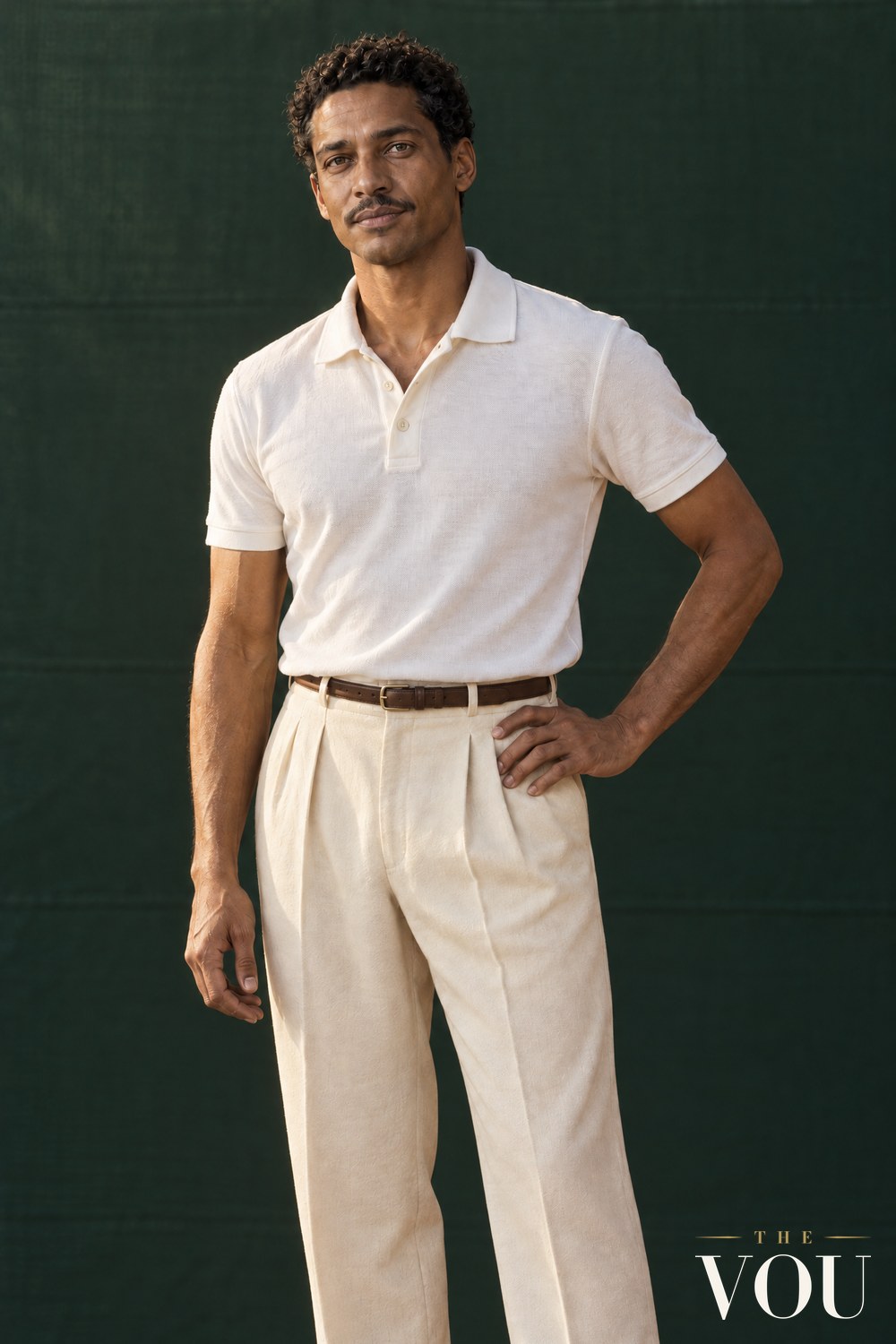
Proportion does the rest. A short, slightly boxy polo tucked into high-waisted pleated trousers goes straight back to Lacoste’s 1920s line.
A long, loose one left out over wide jeans belongs to the street. Same garment, two attitudes, and the difference is a few centimetres of hem. For the practical side of fit, fabric and when to tuck, our men’s polo shirt guide goes into detail.
One collar, several wardrobes
Few garments cross aesthetic camps as easily. In streetwear, a heavyweight jersey polo or a striped, rugby-adjacent one does the job of a graphic T-shirt with more structure, because the collar gives a loose silhouette an anchor at the face.
Minimalists strip it back to line and surface, a tonal fine knit in charcoal, espresso, bone or ink blue with no visible emblem at all.
The retro and collegiate route borrows from the shirt’s mid-century peak without turning into costume. Think ribbed knit polos with contrast tipping, airy Riviera open knits and terry towelling, the wardrobe of 1960s Italian coastal cinema filtered through Japanese Ivy collectors.
And in smart-casual dressing, which our guide to the smart casual dress code unpacks, a crisp collar frames the face with more intent than a crew neck, so the same polo carries you from a studio meeting to a gallery opening to dinner.
That flexibility is the real reason the polo has outlasted a hundred micro-trends. Men tired of chasing a new look every season want pieces they can make personal, and few are as easy to make personal as this one.
If you are still working out which of these camps is yours, our directory of all men’s styles is a good place to start.
Tailoring loosens its tie
The clearest sign of the polo’s promotion is where it now sits, under a suit. Twentieth-century menswear kept strict borders. Structured tailoring meant authority, sportswear meant exertion and casual clothes meant time off. Contemporary dressing has stopped respecting those borders.
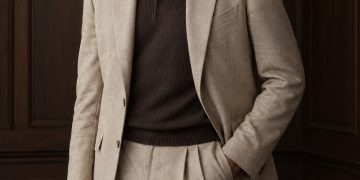
A fine-gauge knit polo worn under a soft-shouldered, unstructured suit, its collar resting over the lapels instead of trapped under a tie, no longer looks like a compromise or a missing shirt. It looks deliberate.
The tailoring becomes easier to live in, and the polo borrows the vertical discipline of pleated trousers and a cleanly cut jacket. Our guide to the polo shirt for business shows how far that goes at work.
There are limits, and they are worth stating. A polo is not black tie, it is not a formal wedding, and a thick piqué polo with a large chest logo under a blazer still looks like the drive home from the golf club. The fine knit is what makes the combination work.
Underneath all this sits a wider change in how men signal confidence. For generations, polish meant armour, a starched collar, knotted silk, padded shoulders, rigid symmetry.
A growing number of men now prefer to show assurance through ease, texture and proportion. A soft collar at the collarbone, a knit you can see the stitches in, trousers with room to move. None of it asks permission, and none of it looks like it is trying too hard.
Making it your own
Lacoste cut his shirt to move freely on a hot court, and nearly a hundred years later that is still the best reason to wear one. The polo has stopped telling people where you belong.
It now tells them how you choose to dress, which is a more useful thing for a shirt to say.
If you want to know which version suits you, our fashion style quiz names the styles closest to how you already dress. For a professional eye on fit, fabric and colour, the stylists listed in our directory of image consultants and stylists work with men on exactly these choices.
#Polo #Shirt #Style #Preppy #Tennis #Court #Runway #VOU


