


Black dandyism runs from the finery forced on enslaved servants
in eighteenth-century England to the clothes that free men chose for
themselves, in Harlem, London and beyond. Here is where it came from,
what men actually wore, and how to wear it now.
Olaudah Equiano bought a suit for his freedom before he had won it.
“In this expectation I laid out above eight pounds of my money for a
suit of super-fine blue cloaths to dance in at my freedom,” he wrote in
The
Interesting Narrative, the autobiography he published in 1789.
Monica L. Miller, a Barnard College professor and the guest curator of
the Met’s 2025 exhibition on Black style, explains in an
essay
for the museum that by then he had assembled nearly all of the funds
and his emancipation appeared certain. The manumission he copies into
the book is dated 10 July 1766. At the dances he gave as a free man, he
recalled, “my Georgia superfine blue cloaths made no indifferent
appearance, as I thought.”
More than two and a half centuries later, the Met used his sentence
about the suit as the epigraph to the introduction of that exhibition,
Superfine:
Tailoring Black Style. Miller titled her essay No Indifferent
Appearance, a phrase from his account. A suit bought in hope and worn in
freedom is a good place to begin.
What Black dandyism is
The Met’s
exhibition
page traces Black dandyism to the intersection of African and
European style traditions, and Superfine examined three hundred years of
Black style in 12 sections, from Ownership and Presence to Cool and
Cosmopolitanism. Miller’s essay calls Black dandyism “a sartorial style
that asks questions about identity, representation, and mobility”. A
2025
CFDA
feature reports the fashion historian Jonathan Michael Square’s view
of Black dandyism as a deliberate use of clothing to challenge racial
hierarchies and claim autonomy. Square was a member of the exhibition’s
advisory committee.
Not every elegant man wanted the word.
Barnard
Magazine reports that W. E. B. Du Bois, although known as one of the
most stylishly dressed Black men of the early twentieth century, was not
keen on being called a Black dandy, and that Miller’s research found
that dandyism in his time could be seen as a stereotype related to
blackface, which he fought against. In this article the term names a
history and a way of dressing, never a label for every Black man in a
good suit. The VOU’s
guide to dandy
style covers British and French dandyism, and this article follows
the Black tradition, which shares much of that tailoring but has its own
history.
Before
Harlem, fine clothes could mean ownership or freedom
Miller describes how dandified servants, then known as “luxury
slaves”, were displayed as figures of conspicuous consumption, their
fine clothes a sign of symbolic rather than manual labour. Fine textiles
also served as currency in the purchase of enslaved people, she
notes.
Julius Soubise moved from the finery of ownership to the style of a
free man. Born enslaved in the Caribbean, he was taken to England, where
in the household of the Duchess of Queensberry he was “educated in the
art of being a gentleman”, according to the Met’s
guide
to the exhibition. Once emancipated, he became known for his pointed
reworking of dandy style, and the guide notes his fondness for expensive
hothouse flowers and perfume. The
publisher’s
description of Miller’s 2009 book Slaves to Fashion adds that he
sometimes wore diamond-buckled, red-heeled shoes. Superfine opened its
Presence section with a 1772 print of Soubise, whom Miller counts among
the first known Black dandies.
Few garments worn or made by enslaved people survive. Miller writes
that such clothing, whether worn in domestic settings or in the fields,
in the Americas or in Europe, was overwhelmingly neither valued nor
preserved, and that men are the most visible figures in the record
because they were the most chronicled in travel narratives and among the
first authors of memoirs.
Frederick
Douglass’s tailcoat, and his warning
Among Miller’s favourite objects in Superfine were Frederick
Douglass’s nineteenth-century tailcoat, top hat and waistcoat, Barnard
Magazine reports. She told the magazine that seeing the garments arrive
at the Costume Institute had felt like a privilege.
Douglass had firm views on dress. In “There Is Something in Dress”,
printed in Frederick Douglass’ Paper on 25 May 1855 and used by
Superfine to open its Respectability section, he criticised both the man
who invites attention to his fine clothes and the man who pays no
attention to his dress, and held that the respectability and dignity of
Black Americans must be upheld. Superfine’s Respectability section
presents dress as one way Black leaders, Douglass among them, projected
pride and earned respect.
Harlem
dressed for the studio, the church and the street
James Van Der Zee moved to Harlem in 1906 and opened a portrait
studio in 1916. He documented Harlem’s growing Black middle class and
celebrities such as the entertainer Florence Mills and the dancer Bill
“Bojangles” Robinson, and he was the official photographer of Marcus
Garvey and the Universal Negro Improvement Association. His portraits
were stylised tableaux with studio props, and he retouched and
hand-tinted the prints, which project “a sense of glamour,
sophistication, and prosperity”, in the words of the
Smithsonian
American Art Museum.
In the Met’s
Harlem
Is Everywhere conversation, the Pulitzer Prize-winning journalist
Robin Givhan described the men in Van Der Zee’s portraits. She pointed
to their “wonderful fedoras”, said that they “look effortful”, and
observed that they were following “a certain template”. Recalling that
there was no such thing as coming to church on a Sunday informally, she
remembered her father in a Borsalino fedora and a cashmere overcoat, and
called such clothes, to her mind, the hallmarks that came out of the
Harlem Renaissance. She also described how Black men and women could not
just go into any store: some were prohibited from going in, and in
others they might buy a hat but not try it on.
The podcast’s host, the writer and art critic Jessica Lynne, noted
that Van Der Zee’s sitters included people he stopped on the street and
asked to pose. The art historian Bridget R. Cooks, quoting Deborah
Willis, called Van Der Zee’s premises “a studio of transformation”.
Speaking more broadly about portraiture of the period, Cooks noted that
not everybody is shown smiling, and set work by Black artists against
racist caricatures in which the smile was part of the uniform.
The zoot suit belongs to this story too, although its wider history
reaches well beyond Harlem. Superfine’s Jook section described the zoot
suit, worn by “hepcats” like the jazz musician Cab Calloway, as a symbol
of transgression, joy and youth in its rejection of traditional
tailoring.
Harlem’s tailors, and
Dapper Dan’s leather
Harlem’s clothes also came from Harlem’s workrooms. Miller’s essay
names tailors such as James McFarland, known as “Gentleman Jim”, who was
active on Harlem’s 125th Street in the 1960s and 1970s and whose clients
included Muhammad Ali, Jackie Robinson and James Brown, among many
others. Superfine noted that Ali’s signature Everlast shorts were “a nod
to the formalism of a tuxedo”, and that outside the ring he enjoyed
wearing bespoke suits.
Dapper Dan opened his Harlem boutique in 1982,
Interview
magazine recounted in 2018, introducing a conversation between him
and the rapper Nas. He told Nas that he had taught himself textile
printing and come up with a chemical for leather that would last. He
kept the cans secret so that nobody knew what kind of ink he was using,
and Eric B. and Rakim, Big Daddy Kane and LL Cool J were all frequent
patrons. Superfine’s Cool section credited his luxury-label-inspired and
branded clothes with coming to define hip-hop style in the 1980s. His
trademark was turning the logos of Gucci, Louis Vuitton and Fendi into
patterned looks, and when the labels’ lawyers came calling, he closed up
shop, in Interview’s telling. By the time of the interview, Gucci had
provided him with an atelier uptown and the two were officially
collaborating.
The CFDA’s 2025 feature credits André 3000 and Big Boi of OutKast,
along with Pharrell, with long challenging conventions in rap and
hip-hop culture, from plaid suits and multicoloured ties to
extraordinary hats and bold, vibrant ensembles.
Britain
wrote its own chapter, from the Windrush to Savile Row
Caribbean men of the Windrush generation mostly took their style cues
from African American performers, Fedora Abu wrote for
MR
PORTER in 2023, and the passengers’ suits reflected American
menswear of the time, most notably the zoot suit. Trousers were
typically high-waisted and wide-legged, the article adds, and jackets
ran long with generous lapels. The passengers included 34 tailors, among
them Clifford Fullerton, who began working as a tailor in North
Kensington and became the first Black associate member of the City of
London Master and Foreman Tailors Society.
Hackney
Museum’s 2025 article on the fashion of the borough’s Windrush
generation quotes Wendy Ellison, who remembered that most of the men she
knew as a post-war child had navy blue pinstripe suits they were
demobbed with, until West Indian friends arrived and she saw men in “a
light blue suit, or a fawn suit, with matching Trilby hats”. The museum
also describes Sunday best, the tradition of wearing your smartest
clothing to services, often with gloves and a hat to complete the
look.
On Savile Row itself, Andrew Ramroop, born in Trinidad, came to the
UK aged 17 in 1970 and was working on the street by 1974, MR PORTER
records. In 1988, when Maurice Sedwell retired, Ramroop acquired the
business and became the first Black person to own a shop on the street.
Ozwald Boateng, born in London to Ghanaian parents, opened his first
retail store on Vigo Street, at the end of Savile Row, in 1995, at the
age of 28, and his first headquarters on Savile Row in May 2002, as his
house’s
own history records. Joe Casely-Hayford trained as a tailor before
launching his own label in 1983, became creative director of Gieves
& Hawkes in 2005 and started an eponymous label with his son,
Charlie, in 2009. Joe Casely-Hayford died in 2019.
Boateng’s house describes its
signature
Kente pattern as a modern interpretation of traditional Ghanaian
Kente cloth, and each pattern in its Adinkra collection as a modern
translation of a traditional Adinkra symbol. Superfine featured the
British designers Joe and Charlie Casely-Hayford and Grace Wales Bonner,
and Charlie Casely-Hayford told
MR
PORTER that “Black dandyism is a powerful reclamation of identity,
autonomy and self-expression”.
Wales Bonner’s spring/summer 2022 collection, Volta Jazz, drew on the
work of the Burkinabé photographer Sanlé Sory, with a campaign inspired
by 1970s West African studio portraiture, above all Sory’s,
AnOther
reported in 2021. Sory was known for documenting the nightlife of
Burkina Faso, and photographed the country’s young and fashionable on
black-and-white film in his portrait studio in Bobo-Dioulasso. Foday
Dumbuya, born in Sierra Leone, moved to London aged 12 and launched
Labrum in 2014, and
London
Museum calls migration and movement the throughlines of the brand’s
collections. The museum now holds a suit and coat from Labrum’s St Giles
Blackbird collection of autumn/winter 2021, pieces inspired by Olaudah
Equiano. Equiano’s example, in other words, is still being cut and sewn
in London.
Who makes the image matters
The scholar, filmmaker and curator Shantrelle P. Lewis founded the
Dandy
Lion Project in 2010. It began as an exhibition in a pop-up gallery
space in Harlem at Ngozi Odita’s SOCIETY H.A.E., and grew into a
travelling exhibition and a book, published by Aperture in 2017.
Ralph Lauren’s 2022 collection with Morehouse and Spelman Colleges
was conceptualised and designed by Morehouse and Spelman alumni at the
company, and referenced styles worn by the colleges’ students from the
1920s to the 1950s. Its wool flannel blazer is an homage to the
Morehouse blazer, a garment traditionally given to students during their
first days on campus. The collection also marked the first time the
brand had produced a campaign with an all-Black cast and creative team,
shot by the photographer Nadine Ijewere, according to the
company’s
announcement.
Vogue’s May 2025 issue had four covers of Met Gala co-chairs, each by
a different image-maker,
The
Fashion Spot reported. Tyler Mitchell photographed A$AP Rocky,
Malick Bodian photographed Lewis Hamilton, Iké Udé photographed Colman
Domingo and the artist Henry Taylor painted Pharrell Williams. Rocky was
styled by Law Roach and shot his spread in and around his native Harlem,
including the home of the poet Langston Hughes,
The
Root reported.
Superfine ran at the Met from 10 May to 26 October 2025, organised by
Miller as guest curator with Andrew Bolton, the curator in charge, and
inspired by her 2009 book, Slaves to Fashion, the museum’s
announcement
said. Colman Domingo, Lewis Hamilton, A$AP Rocky, Pharrell Williams and
Anna Wintour co-chaired the Met Gala on 5 May 2025, with LeBron James as
honorary chair. Vogue revealed the dress code, Tailored for You, in
February 2025,
ABC7
reported.
Outfits on the record
The outfits below are documented, each described by a museum, a
critic, a caption or the person who chose it.
Van Der Zee’s own clothes,
1918
In a self-portrait from 1918,
Christie’s
notes, Van Der Zee wears white trousers and a striped shirt with the
sleeves rolled up, a knitted tie secured near the third button and a hat
tilted with his head. The writer, Camille Okhio, says the trousers look
to be linen.
Portrait of a Couple, 1924
The
National
Gallery of Art describes a man in a three-piece tuxedo who holds a
bowler hat and cane in his right hand, wears rings on each of his little
fingers, and has a chain across his waistcoat, tucked into the same
pocket as his thumb.
On the Town, 1929
The
Studio
Museum in Harlem describes the man’s crisp white tuxedo and top hat
against the illusionistic backdrop of a dignified parlour, a combination
that suggests he is on his way to a fashionable banquet or club. The
blues singer Gladys Bentley was also known for a white tuxedo and top
hat, and Miller writes that, worn by provocative women such as Bentley,
the tuxedo could communicate queerness and androgyny.
Couple, Harlem, 1932
In the Met conversation, Cooks describes the man in the car, which
she calls a very fancy Cadillac, wearing a full-length raccoon coat, and
the woman standing elegantly, with brownstones in the background, during
the Great Depression. She reads the pair as able to maintain respect and
dignity in difficult times.
A$AP Rocky’s Vogue cover, May
2025
British
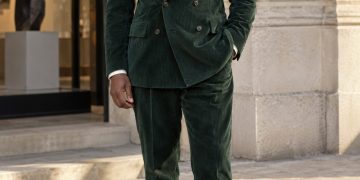
Vogue described Rocky’s cover suit as a double-breasted two-piece in
a “confidently ample, though far from oversized” fit, made in emerald
corduroy by Ozwald Boateng. The
Philadelphia
Inquirer called it a sharp green Ozwald Boateng suit.
Colman Domingo’s Vogue
portrait, May 2025
The caption to Iké Udé’s portrait in
Vogue
credits Wing & Weft gloves, a Bailey 1922 hat, a cane from Michael
German Antiques, Bode shoes, and a Dolce & Gabbana Alta Sartoria
jacket, waistcoat and trousers. When the interviewer hoped he had got at
least one perfect 10, Udé named “Mr. Domingo wearing a Dolce &
Gabbana pale blue three-piece, with a cane and white gloves”, along with
a Balmain look.
The Met Gala, 5 May 2025
Burna Boy wore a single-breasted red suit with a sherbet yellow shirt
under a textured leather overcoat by Ozwald Boateng,
10
Magazine reported. Lewis Hamilton wore an all-white Wales Bonner
tuxedo with coattails and a beret. Domingo arrived cloaked in a regal
blue robe, then revealed a sequinned chequerboard blazer, pearl ear
halos and grey tailored trousers finished with a polka-dot scarf, by
Valentino.
Jacques Agbobly’s denim in
Superfine
In the exhibition’s Heritage section was a four-piece denim ensemble
by the Brooklyn-based designer Jacques Agbobly, embellished with beads,
which, Miller explains in Barnard Magazine, “is an homage to his aunts”
and the earrings they wore when dressing for church.
Recognising the clothes
Superfine’s introduction describes dandyism expressed through precise
dress and tailoring or through flamboyant self-presentation, and Black
dandyism has room for both. The documented looks in this article show
different ways to make clothes personal, from Ellison’s matching suit
and hat colours to Rocky’s generous corduroy tailoring and Agbobly’s
beaded denim. The Met’s Cool section also included khaki, denim,
tracksuits and knitted cardigans, placing carefully styled casual
clothes within this history.
For the outfits below, choose the feature you want to notice first,
such as the jacket’s shape, an unusual cloth or a meaningful accessory.
Build the remaining pieces around that choice. A green corduroy suit
already supplies colour and texture; the ivory shirt in our version
gives the eye somewhere quieter to rest. The fawn suit works
differently, through a pale blue shirt and matching hat. Both are
starting combinations you can adapt to your own occasions.
The wider world of the style
The music runs through the record in named people rather than one
genre: Cab Calloway in Superfine’s Jook section, the rappers who were
Dapper Dan’s patrons, and the OutKast and Pharrell looks the CFDA
describes. The places are specific too: Van Der Zee’s studio, the
churches of Givhan’s Sundays and Hackney’s Sunday best, Gentleman Jim’s
125th Street, Vigo Street and Savile Row, and the home of Langston
Hughes in Rocky’s Vogue shoot. The car in Couple, Harlem belongs to one
photograph, and the bowler, cane, rings and chain to one 1924 portrait.
No watch, house or car belongs to the style itself, and nothing here
makes a man a dandy by owning it.
How to wear it now
The outfits from here on are The VOU’s proposals rather than history,
and each borrows one documented idea instead of copying a look. The
colours are examples, not a verdict on your colouring, and The VOU’s
seasonal colour
quiz and body
shape quiz can help you explore shades and clothing proportions.
A starting wardrobe in eight
parts
Use these eight categories as a wardrobe checklist, keeping the
pieces you already own before buying anything.
- A dark suit, navy or charcoal, whose jacket also works on its
own. - A waistcoat in the suit’s cloth or a quiet contrast, which turns the
suit into a three-piece. - Two or three shirts in white and pale blue, with a point or
semi-spread collar. - Two ties, one knitted and one in silk.
- Separate trousers and jeans, such as grey flannel trousers and
straight dark indigo denim. - A navy blazer in wool flannel, after the Morehouse blazer.
- Two pairs of leather shoes, black Oxfords and brown suede Derbies or
loafers. - One personal piece with a story behind it, such as an inherited ring
or a pocket square you have chosen for a particular memory.
Add to it slowly, by occasion and by taste: a fawn or light blue suit
for daytime celebrations, a white dinner jacket for a suitable
warm-weather black-tie invitation, a suit in a stronger colour, and a
felt hat or a long overcoat only if you like hats and your climate asks
for a coat.
A
fawn suit for a daytime celebration, after the Windrush arrivals
Wear a fawn single-breasted suit in a lightweight wool with a pale
blue shirt, a brown knitted tie, brown socks and dark brown suede
Derbies. A trilby matched to the suit echoes Ellison’s recollection;
felt is our choice for this version, and the hat is optional. Remove it
when you sit down indoors. Wear it to a spring or summer daytime
wedding, a christening or a family party.
A
charcoal three-piece for dinner or the theatre, after the 1924
portrait
The portrait shows a three-piece tuxedo, and this is an everyday
adaptation of the idea rather than a copy. Wear a charcoal three-piece
lounge suit, a white shirt, a burgundy silk tie, black socks and black
cap-toe Oxfords, and run a plain watch chain from a waistcoat buttonhole
to a pocket. Let the chain lead, or wear a ring instead if you prefer.
Wear it to a smart dinner, the theatre or an evening concert, not to an
event that asks for black tie.
A
white dinner jacket for a warm-weather black-tie evening, after On the
Town
For the black-tie foundation,
Debrett’s
specifies a dinner jacket with silk peaked lapels or a shawl collar,
black trousers with a single row of braid down each outside leg, and a
white evening shirt. The
Emily
Post Institute permits a white dinner jacket with the rest of the
black-tie wardrobe in summer, in the tropics or on a cruise, while
Debrett’s notes that white dinner jackets were traditionally worn in hot
climates but not usually in Britain, even in summer. Ask the host before
choosing white for a British black-tie invitation.
For an occasion where white is welcome, wear a white dinner jacket
with braided black trousers, a white evening shirt with studs and
cufflinks, a hand-tied black silk bow tie, black silk socks and black
patent Oxfords. Add a black cummerbund or a low-cut evening waistcoat if
you want a waist covering, using one rather than both. The VOU’s
black-tie
guide covers the dress code event by event. Leave the top hat to the
photograph.
A
green double-breasted suit for an evening opening, after A$AP Rocky’s
cover
Wear a deep green double-breasted suit, in corduroy for cooler
weather or lightweight worsted wool for a warmer evening, with an ivory
shirt, a dark brown knitted tie, dark green socks and dark brown suede
loafers. Ask for a generous cut that still follows your shoulders,
rather than a suit that is simply too big. Wear it to a gallery opening,
an evening performance or a dinner where a suit is welcome.
Denim and
one personal piece, after Jacques Agbobly
This is the relaxed one. Wear straight dark indigo jeans, a white
Oxford-cloth shirt tucked in, the navy flannel blazer from the starting
wardrobe, navy socks and burgundy leather loafers, with no tie. Add one
personal piece with a story, such as an inherited ring or a brooch.
Agbobly’s beads were an homage, and the lesson is to let one meaningful
object carry the reference rather than to copy beaded denim. Wear it to
a weekend lunch, an exhibition or an informal dinner.
Through the year, move between the lighter cloths and pale suits of
summer and the flannel and corduroy of winter, and add the overcoat and
hat only when the weather or your taste asks for them.
Common
mistakes, and the styles it is confused with
The first mistake is copying a gala look whole. For an ordinary
dinner or celebration, try one idea from the gala looks, such as a pale
three-piece or green suit, with familiar shirts and shoes. The second is
buying labels instead of fit. Before paying for another label, try the
jacket and trousers you own with the intended shirt and shoes, and check
whether an alteration would make that outfit work. The third is
reproducing a whole period outfit without considering the occasion. For
a first attempt, borrow its silhouette, colour pairing or one accessory,
then build around clothes you wear comfortably. The fourth is mistaking
oversized for generous. Rocky’s cover suit was ample but, in British
Vogue’s words, “far from oversized”, which is the difference to ask a
tailor for.
La Sape and the swenkas sit close to Black dandyism but have their
own histories: a passage by Maurice Berger quoted on the Dandy Lion
Project’s site describes la Société des Ambianceurs et des Personnes
Élégantes as originating in the French-speaking Congo, and the swenkas
as “the debonair working-class Zulu men of South Africa”. The zoot suit,
too, has a longer and wider story than its Harlem chapter. The European
tradition of British and French dandyism is covered in The VOU’s guide
to dandy style, linked above.
Start from your own wardrobe
Start with the outfit you will wear first, then set out the jacket,
trousers, shirt and shoes you already have for it. Have a tailor check
that the waistcoat covers the trouser waistband when you stand and when
you sit, that the trousers break cleanly on the shoe, and that the
jacket follows your waist without pulling. If you order a suit, ask how
much room its construction leaves for later alterations and which
fittings the price includes. In
Henry
Poole’s bespoke process, extra cloth called inlays is left at
certain seams so that the suit can be altered later, and the cutter
adjusts the suit to the client’s posture at the first fitting. For
lapels,
Oliver
Wicks’s guide distinguishes the versatile notch, the upward-pointing
peak and the curved shawl shape associated with dinner jackets. A notch
is a straightforward starting point for the daytime suit, while a peak
gives the green double-breasted outfit a stronger line. Spend on the
missing piece or alteration that completes your chosen outfit; leave the
other purchases until you have a use for them.
Going further on The VOU
To find where this style sits among the others you like, take The
VOU’s fashion
style quiz or the
style
personality quiz. If you would like a wardrobe built around your own
references and occasions, The VOU’s paid
Professional
Fashion Style Analysis for Men starts with a detailed form about
your interests, work and goals, and provides a downloadable PDF within
one week, listing your top three styles in order of relevance, three
outfit ideas for each and a shopping guide. The package also includes a
week of extended support.
#Black #Dandyism #Men #Equianos #Superfine #Suit #Harlem #Savile #Row


